Transform Ordinary Scenes into Compelling Images
You have learned how to control light with the Exposure Triangle. Now it is time to learn how to arrange elements within your frame. Great composition is what separates snapshot from photograph — and the good news is, it is completely learnable.
In this lesson, we will explore six powerful composition techniques that professional photographers use every day.
1. The Rule of Thirds
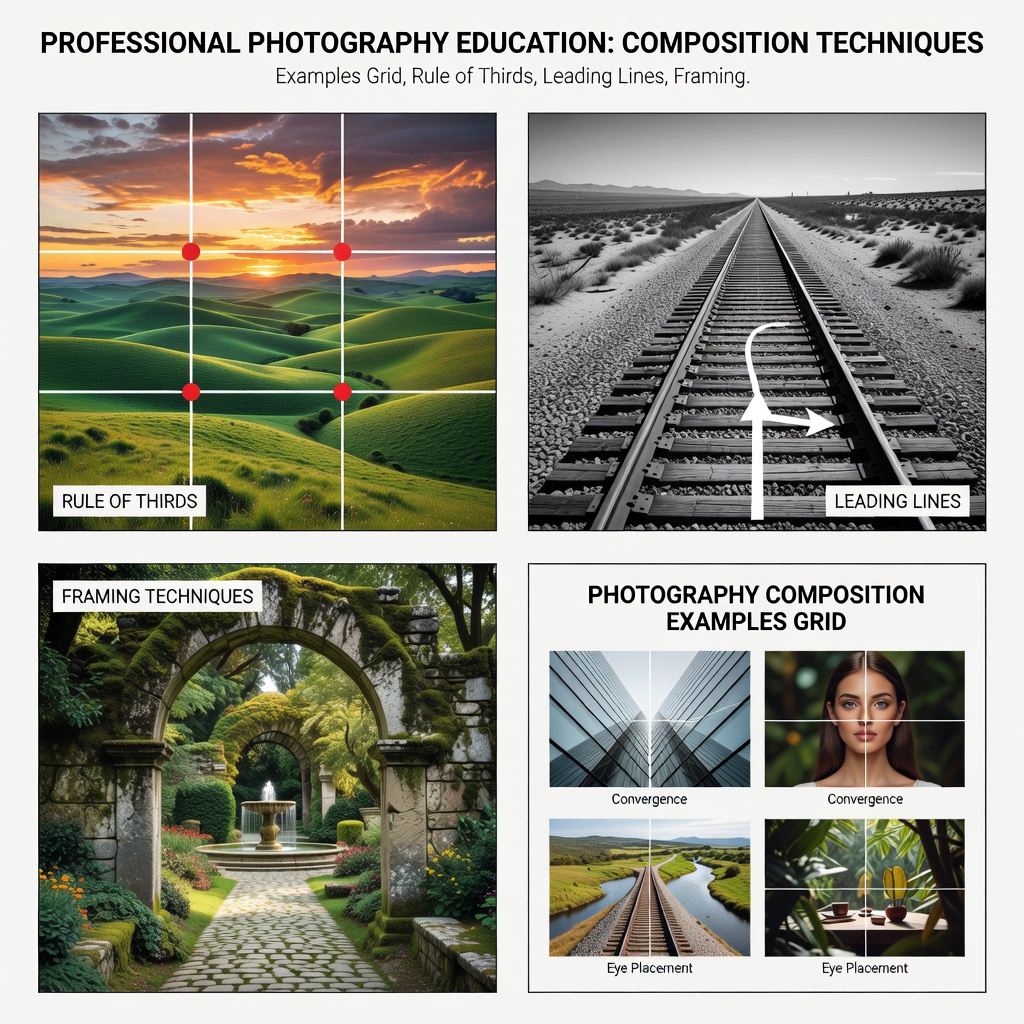
Imagine your frame divided into a 3×3 grid. The Rule of Thirds says: place your main subject along these lines, or at their intersections (called power points). Our eyes naturally gravitate toward these positions rather than the center.
Landscapes: Place horizon on top or bottom third line — never dead center (unless intentionally symmetric).
Portraits: Align eyes with the top third line. Place your subject on left or right vertical line.
Action shots: Leave space in front of moving subjects — where they are going, not where they have been.
2. Leading Lines
Our eyes naturally follow lines. Use roads, fences, rivers, shadows, or architectural elements to guide viewers into your image — ideally toward your main subject.
Types of leading lines:
- Converging lines: Roads, railroad tracks that meet at horizon
- Diagonal lines: Stairs, fences, architectural elements — add energy and movement
- Curved lines: Rivers, winding roads — softer, more organic feel
- Implied lines: A subject looking off-frame creates invisible leading line

3. Framing and Negative Space
Natural frames: Use elements in your scene to frame your subject — doorways, windows, archways, tree branches. This adds depth and draws attention to your main subject.
Negative space: The empty space around your subject is not wasted — it gives the eye a place to rest and can emphasize your subject dramatically. Minimalist photography relies heavily on negative space.
Tip: Both techniques work by creating contrast — framed vs. unframed, filled vs. empty.
4. Symmetry and Patterns
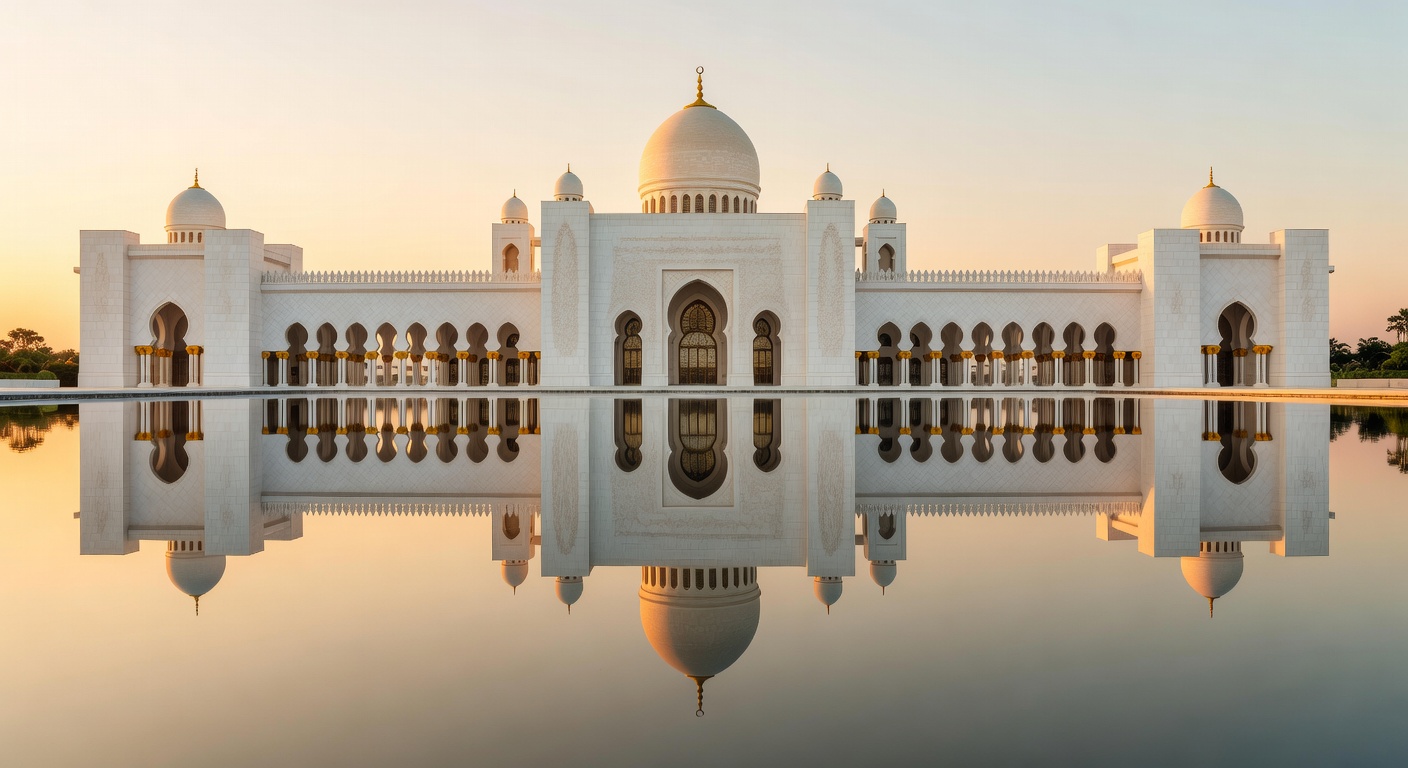
Humans love symmetry — it is inherently pleasing to the eye. Look for:
- Perfect symmetry: Architecture, reflections in water
- Near-symmetry: Slight variations that add interest
- Patterns: Repeating elements — tiles, windows, clouds, crowds
The pattern breaker: Find a pattern, then break it. A row of identical chairs with one different — suddenly the image has a story.
5. Color and Contrast
Color can make or break a composition:
- Complementary colors: Opposites on the color wheel (red/green, blue/orange) create vibrant contrast
- Analogous colors: Neighbors on the wheel (blue/green, red/orange) create harmony
- Color dominance: Limit your palette — 2-3 colors work better than a rainbow
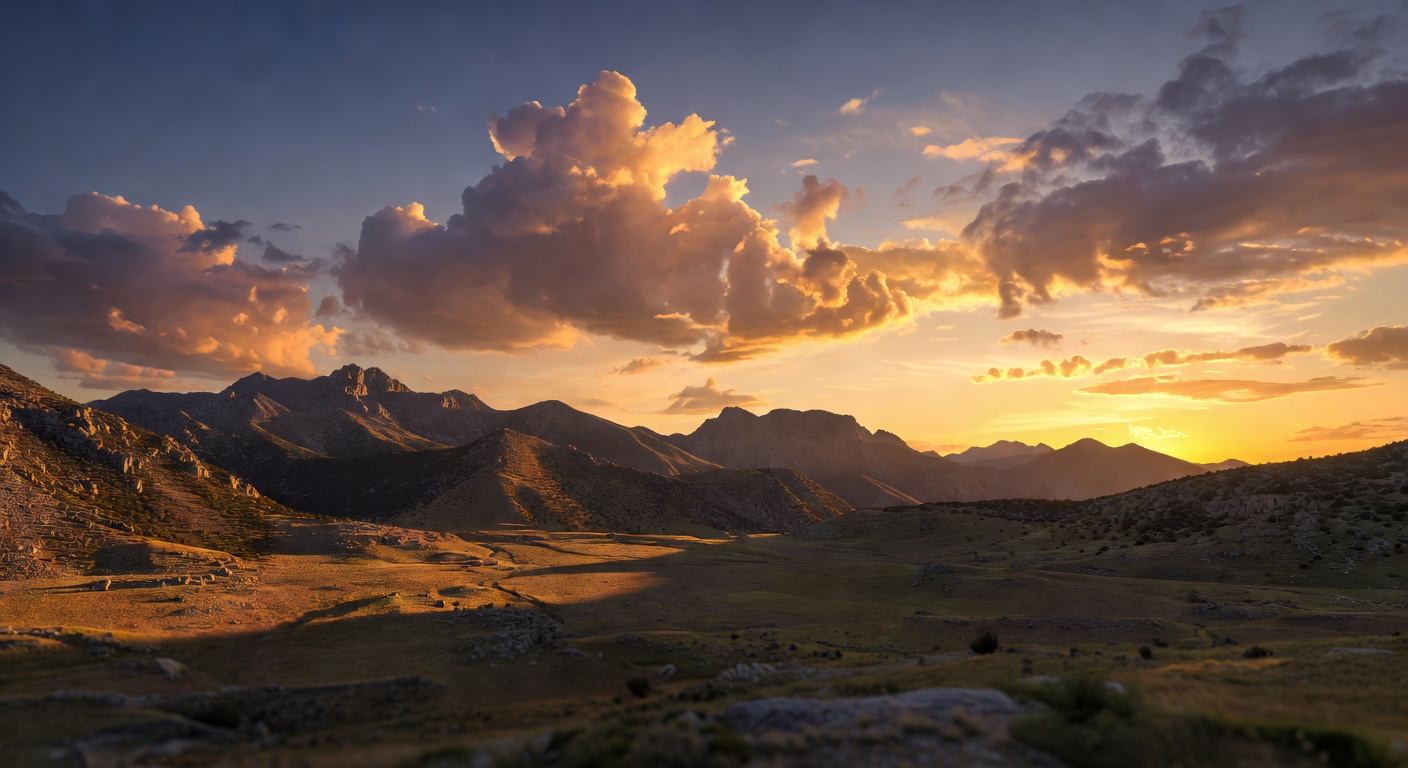
High contrast: Strong light creates dramatic shadows and highlights. Shoot during golden hour or harsh midday sun for maximum impact.
6. Fill the Frame
Sometimes the best composition is simplest: fill the entire frame with your subject. Eliminates distractions, creates impact, works especially well for portraits, textures, and details.
Practical Exercises
Now it is time to practice! Here is your composition challenge:
Exercise 1: Rule of Thirds Marathon (10 shots)
Go outside and shoot 5 landscapes (horizons on third lines) and 5 portraits (eyes on top third). Compare centered versions to thirds versions.
Exercise 2: Lines Hunt (15 shots)
Find 5 leading lines, 5 diagonal lines. Bonus: Create converging lines with you as the subject (use timer).
Exercise 3: Frame and Space (12 shots)
Shoot 6 with natural frames (windows, branches), 6 with negative space around a small subject.
Exercise 4: Pattern Quest (10 shots)
Find 5 symmetrical shots, 5 pattern shots. Add one pattern breaker element to a pattern.
Exercise 5: Color Challenge (15 shots)
Shoot 5 warm tones (sunrise/sunset), 5 complementary pairs, 5 high-contrast black and white conversions.
Exercise 6: Ultimate Mashup (10 shots)
Combine 2+ techniques in each shot. Share on social media with #CompositionQuest!
Your Journey Continues
Composition is 90% observation. Slow down, scan the entire frame, ask yourself: where is the viewer’s eye going? What can I remove? What element can I add?
In our next lesson, we will explore lighting — natural and artificial — and how to use light to create mood and dimension in your photographs.
Grab your camera and start seeing the world through a composer’s eyes!